


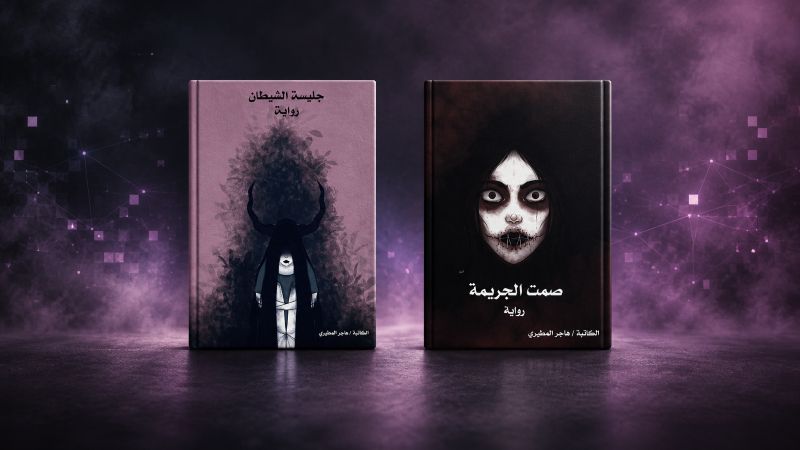
Kuwait – By Dalal Abdulaziz
For readers navigating a world of constant alerts and unsettling headlines, fiction need not offer an escape from anxiety. It can also provide a language for it. Kuwaiti author Hajar Al-Mutairi works within this territory, drawing on psychological horror and mystery to explore the tension between ordinary lives and forces that resist explanation.
Rather than treating fear as a device for suspense alone, her fiction places uncertainty at the center of the human experience. Ambition, vulnerability, and the desire for control become the foundations of narratives in which the familiar can quickly turn threatening.
The Unknown as a Psychological Landscape
In Jaleesat Al-Shaitan (The Devil’s Companion), a young woman’s studies and daily life are disrupted by unforeseen events. Beyond its thriller premise, the story sets personal ambition against circumstances that cannot easily be understood or controlled. The unknown becomes more than an external threat: it tests the character’s sense of agency and the stability of the future she imagines.
A similar concern runs through Samt Al-Jareema (The Silence of the Crime), where horror and crime provide a framework for exploring psychological pressure and human vulnerability. Read together, these works suggest an interest not simply in what frightens people, but in what fear reveals about them.
The appeal of this approach lies in the relationship between suspense and recognition. Readers may encounter unfamiliar situations, yet recognize the underlying emotions: uncertainty, isolation, and the struggle to retain control when familiar certainties begin to collapse.
From Fiction to the Digital Page
Al-Mutairi’s writing also extends beyond fiction. Her contributions to platforms such as VICE and Manshoor address travel, identity, and social experience, bringing another dimension to the concerns that animate her literary work.
The connection is not merely one of format. Questions of belonging and encounters with unfamiliar environments offer a thematic bridge between her fiction and nonfiction. Where a novel can develop these tensions through character and atmosphere, an article can approach them through observation and reflection.
Digital publishing provides a different setting for that exchange. It places the writer’s work within the reader’s daily flow of information, where the challenge is not simply to attract attention, but to give that attention something worth staying with.
Beyond the Immediate Thrill
Al-Mutairi’s work invites consideration of how genre fiction can engage with contemporary unease without abandoning the pleasures of storytelling. Horror and mystery offer suspense, but they can also make room for questions about identity, resilience, and the limits of personal control.
The lasting interest in such writing lies less in its ability to decode an era than in its willingness to confront what remains unresolved. The mystery draws the reader in; the human uncertainty beneath it gives the story its resonance.
