


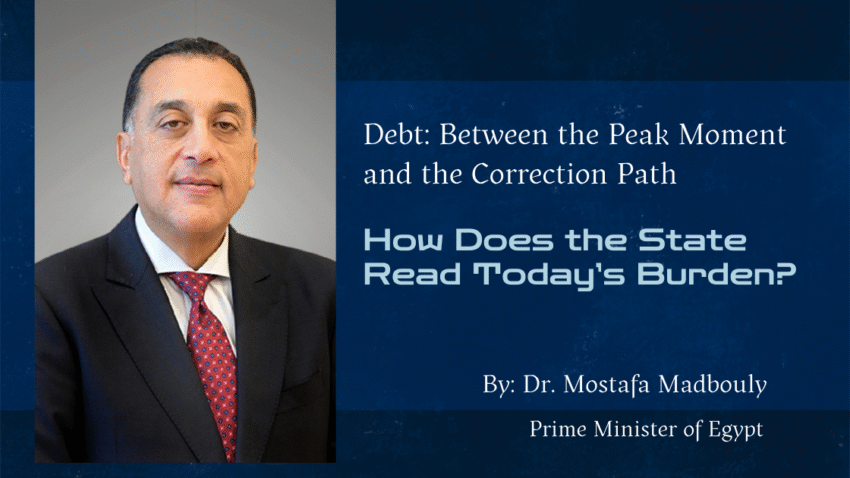
By Dr. Mostafa Madbouly
Prime Minister of Egypt
We are fully aware that the issue of public debt and debt service in Egypt is no longer merely a set of figures circulated in economic reports. It has become a legitimate question for citizens regarding our sustainability and the limits of endurance amidst increasing living pressures. This anxiety grows whenever the cost of living rises or margins for public spending tighten, making the scene appear reduced to a direct equation between high debt and tangible daily pressures.

However, the government’s responsibility requires addressing this question with transparency and depth. Economies are not managed by reductionist logic, nor can their trajectories be understood in isolation from the international context and the successive shocks that have reshaped financing and growth priorities globally in recent years.
Since 2020, Egypt has not moved in a vacuum or an isolated internal circumstance. Like many developing economies, we faced a highly turbulent international environment, beginning with an unprecedented global pandemic, followed by a severe inflationary shock, and succeeded by the fastest cycle of monetary tightening the global economy has seen in decades. In this context, the pressures associated with rising debt and its servicing were a reflection of the cost of maintaining economic and social stability and preventing contraction, not the result of a path separate from these shocks, before the State began today, albeit with difficulty, the transition from crisis management to realigning the path.
It may seem to some that the current figures represent the end of the road. Yet, the Egyptian case demonstrates that the essence of the ongoing transformation is not determined by the volume of debt alone, but by the direction of its movement, its funding sources, and its maturity structure.
In a single year, the State has become a net repayer of external debt by approximately $3.4 billion, even though the total balance remains high due to previous accumulations. Furthermore, existing obligations worth $11 billion were converted into long-term direct investment. This step reflects an intentional shift in financial behavior: moving away from reliance on short-term borrowing toward longer-term partnerships more closely linked to productive capacity. Reinforcing this trend is the fact that long-term debt has come to represent about 81% of total indebtedness, reducing refinancing pressures and granting public finances a wider temporal space for management.
This shift might not appear in the abstract debt figure, but it becomes evident when tracking the movement of inflows and outflows, and determining whether new resources add future repayment burdens or contribute to alleviating them through investment and growth.
This transformation is completed by using unconventional debt management tools, including debt swap mechanisms, in which Egypt played a prominent role in 2024. Egypt was one of only seven countries to execute swap agreements that contributed to lowering external obligations in exchange for redirecting savings toward development projects and social and environmental sectors.
The operation in which Egypt participated was the largest globally during the year. This reflects the State’s reliance on internationally recognized tools to alleviate the financial burden and convert part of debt obligations into resources used directly to support development priorities, rather than continuing to drain them solely in debt service.
Hence, the real question becomes less about how much the debt is, and more about how it is managed, for what purpose it is used, and how its cost is distributed over time. Debt that pressures the budget and crowds out social spending is radically different from debt that is redirected or replaced by investment flows that ease the repayment burden and support growth. The State is operating between these two models today, on a complex path that is not without cost, but which reflects an intentional direction to transition from the logic of emergency financing to the logic of sustainability and fiscal discipline.
In this framework, the government realizes that the ongoing debate about debt is linked to a specific moment in time where past obligations intersect with subsequent correction attempts, causing numbers to appear at their most acute before they begin to recede. International experiences indicate that the cost of transformation often manifests first in the form of high financial pressures before the effects of restructuring and changing financing tools are reflected in sustainability indicators and maneuvering capacity.
Thus, the fairness of assessment is determined between an instantaneous reading of burdens and a deeper reading of a trajectory that is being worked on but whose results are not yet complete.
Accordingly, the government’s dealing with the debt file is not based on a duality of defense or condemnation, but on a more complex reading that distinguishes between situational pressures and strategic choices. A state passing through a peak in debt service is not necessarily a state moving in the wrong direction, just as improved figures in the short term do not necessarily mean economic fundamentals are entrenched.
Therefore, the most important criterion in evaluating policies remains the direction of movement: Is the financing structure changing? Is reliance on short-term debt declining? Are financial obligations being replaced by flows capable of generating sustainable value-added? At this point, the evaluation becomes objective, and the discussion moves from the noise of numbers to the essence of policies and their real impact.
From this standpoint, the government sees the current stage as a test of the solidity of choices more than a test of their theoretical soundness. Transitioning from an economy dependent on rapid debt flows to an economy that attracts longer-term investment and redistributes financing burdens over time cannot be done without cost, nor does it pass without tangible social and financial pressures. However, the fundamental difference lies in the fact that this cost, despite its harshness, is linked to a conscious attempt to break the cycle of recurring indebtedness, not to perpetuate it; and to rebuild a more balanced relationship between financing and growth, not to temporarily escape obligations.
The greatest challenge remaining before the government is how to manage this moment with public opinion, not by minimizing the size of the burden or denying it, but by placing it in its correct context, explaining its causes and limits, and the expected path to dismantling it.
Financial crises are not measured only by the severity of their numbers, but by the state’s ability to turn them from a point of weakness into a motive for restoring discipline, and from an immediate pressure into a long-term corrective path whose success is measured by the passage of time and real impact, not by a single moment.
In recent years, a proposition has emerged in public debate linking the public debt file to the financing of specific projects. It presents this in a single narrative that reduces the crisis to projects alleged to be economically futile, such as roads and new cities, versus the neglect of what is known as “human development.” This proposition has found resonance with wide sectors of public opinion because it offers a direct and simplified explanation for a complex issue, turning an intricate economic discussion into a single, easily circulated cause.
However, this reading, despite its simplicity, does not reflect the full picture. It confuses direct financial return with long-term macroeconomic return. It ignores that infrastructure projects are not established as profit-making ventures, but as investments that lower production and transport costs, raise labor productivity, and increase the economic value of assets, conditions indispensable for improving education, health, and creating sustainable job opportunities. Furthermore, human development itself cannot be achieved in a vacuum; it requires an urban and service environment capable of accommodating economic activity and attracting investment.
This proposition also overlooks that debt was not the product of these projects alone but was formed in the context of successive external shocks that forced the State to finance existing gaps to maintain economic and social stability. Moreover, social spending did not stop, but it was subjected to pressures that reduced its apparent impact due to inflation and population growth. Thus, reducing the debt crisis to “roads and bridges” does not offer an accurate diagnosis so much as it distances the discussion from the most important question: How do we transform the physical investments already achieved into a real productive base that reinforces human development, instead of placing “investment in stone” and “investment in humans” in a false confrontation?
In this context, the government is committed to ensuring that the debt management path is part of a broader vision for reform, not a goal in itself. The true standard for the success of economic policies will not be merely a decline in numbers, but their ability to be reflected in citizens’ lives through an economy more capable of creating jobs, improving service quality, and enhancing justice in distributing the burdens of transformation. Our duty at this stage is to continue on this path with a high degree of discipline and transparency, while acknowledging the social and financial cost and working to alleviate it as much as possible, so that reform becomes a understood and accepted path, not an ambiguous burden that weakens trust between the State and society.
Ultimately, judgment on the debt trajectory is not made at the peak moment, but at what follows it. Nations are not measured by their ability to always avoid crises, but by their ability to manage them and transform them into more balanced and sustainable paths of correction. Our responsibility is to continue on this road with clarity and discipline, and to link debt management to real growth and human development, so that what we endure today becomes a necessary crossing toward a stronger economy more capable of meeting citizens’ aspirations, not a permanent burden restricting the future.
Proceeding from this commitment, the Economic Group is working on studying and implementing a package of exceptional solutions aimed at reducing debt burdens and accelerating the path of fiscal sustainability through integrated measures whose final features are being finalized. In implementation of the directives of His Excellency President Abdel Fattah El-Sisi, President of the Republic, a number of these measures will be announced in the coming days within a clear vision aimed at alleviating pressures on public finances and enhancing the economy’s ability to grow. This will be reflected directly in improving living conditions and expanding the margin of spending on essential services that touch citizens’ lives.
