


Johannesburg: TECHz – News Desk
In a historic shift for American space exploration, NASA Administrator Jared Isaacman announced on February 27, 2026, a sweeping “course correction” for the Artemis program. The reorganization prioritizes mission safety and operational consistency by adding a crucial test flight and standardizing rocket hardware to address long-standing technical delays.

The “Apollo 9” Pivot for Artemis III:
The most significant change is the radical redefinition of Artemis III. Originally slated to be the first crewed lunar landing since 1972, the mission has been transformed into a Low-Earth Orbit (LEO) docking and systems validation flight, now targeted for mid-2027.
Under this revised flight profile, the crew will launch in an Orion capsule to rendezvous and dock with commercial landers – SpaceX’s Starship HLS and potentially Blue Origin’s Blue Moon – while remaining in Earth orbit. This mirrors the strategy used during the 1969 Apollo 9 mission, which tested the lunar module in Earth orbit before committing to a deep-space landing. The primary goal is to validate the complex docking maneuvers and the new “xEVA” lunar spacesuits without the risks inherent in a lunar descent.
NASA leadership emphasized that this “back to basics” approach is necessary to build the “operational muscle memory” required for a sustainable presence on the Moon. Consequently, the first human lunar landing is now officially rescheduled for the Artemis IV mission in 2028.
Artemis II: Repairs Underway in the VAB:
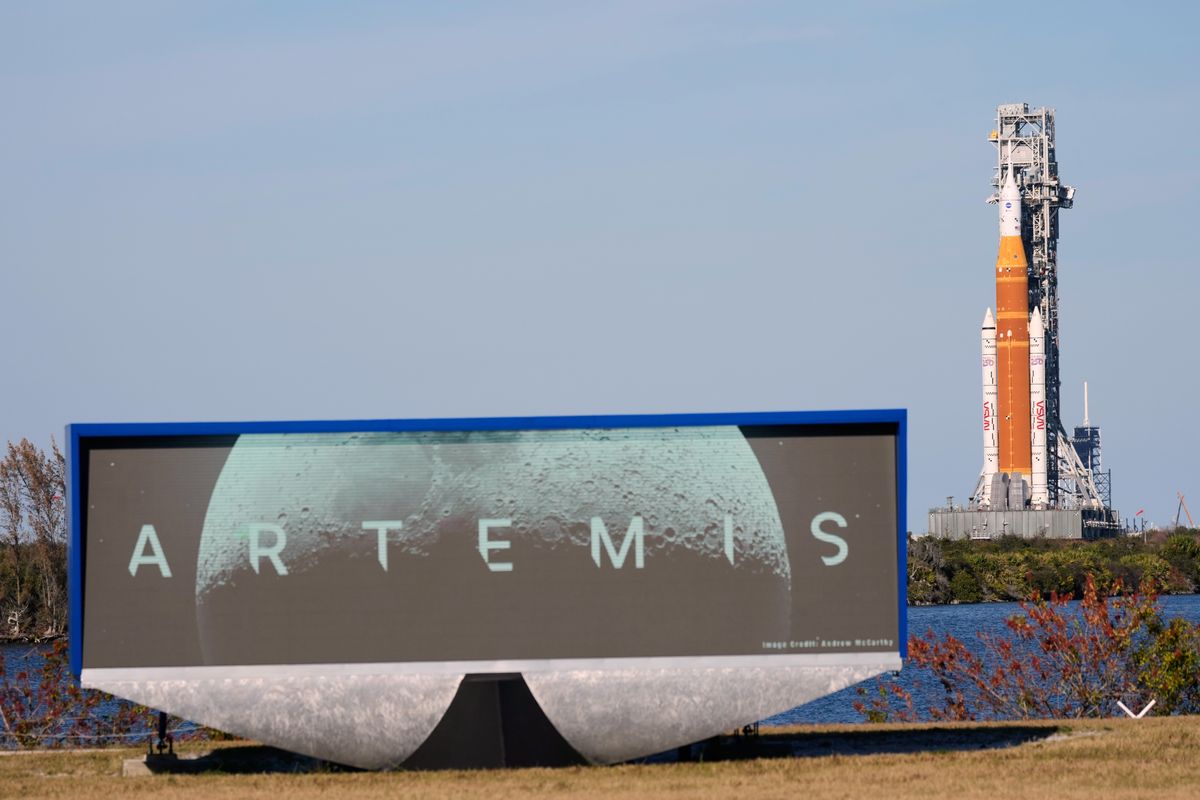
As of March 1, 2026, the Artemis II mission – the program’s first crewed flyby of the Moon – is navigating its own technical hurdles. On February 25, NASA rolled the 322-foot Space Launch System (SLS) rocket back into the Vehicle Assembly Building (VAB) from Launch Pad 39B.
The rollback was triggered by a helium flow malfunction discovered in the rocket’s upper stage during final pre-launch preparations. This issue followed an earlier hydrogen leak that had already pushed the mission out of its February window. Engineers are now working to replace the faulty valves and perform integrated system checks. NASA has stated that the earliest available launch opportunity is now April 1, 2026. The crew, consisting of astronauts Reid Wiseman, Victor Glover, Christina Koch, and Jeremy Hansen, remains in high-readiness training as they await the completion of these critical repairs.
Standardizing the SLS Architecture:
To stabilize the program’s budget and launch cadence, NASA is making a major technical pivot: the cancellation of the “Block 1B” upgrade. For the foreseeable future, the agency will standardize the SLS around the current Block 1 configuration.
This decision halts the development of the more powerful Exploration Upper Stage (EUS), which would have required massive and expensive infrastructure changes at Kennedy Space Center, including a new $1 billion mobile launcher platform. By freezing the vehicle design, NASA aims to achieve a launch cadence of one mission every 10 months. This strategy is intended to eliminate the multi-year gaps between flights that have characterized the program thus far.
A New Roadmap for the Moon:
The revised schedule now envisions a steady progression of capability. Following the Artemis II lunar flyby in April 2026 and the Artemis III orbital test in 2027, NASA plans to execute two lunar surface landings in 2028: Artemis IV in the early part of the year and Artemis V toward the end. This ambitious 2028 “double landing” year is supported by a significant funding boost from Congress aimed at ensuring American leadership in the face of increasing international competition in the lunar south pole region.
