


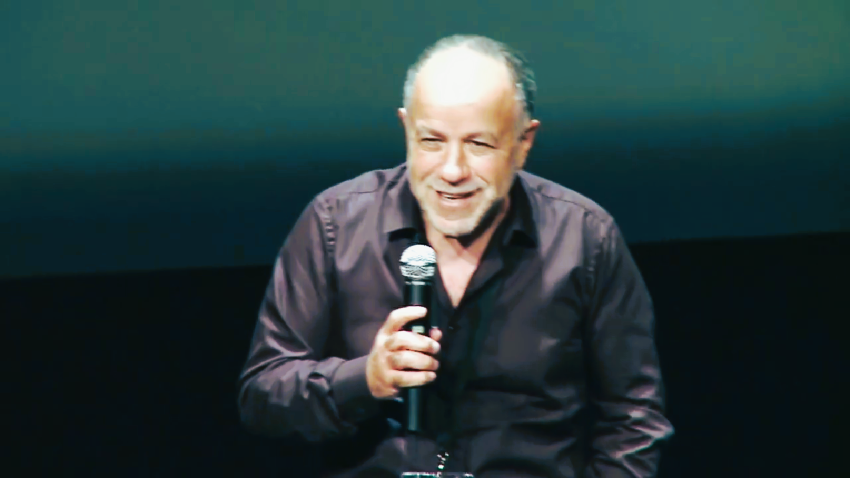
Cairo: TECHz – Ashraf Gaber – Dr. Hatim Zaghloul stands today among a rare breed of scientists who didn’t just contribute to a single technology, but helped rebuild the very infrastructure of the digital world. The man who co-authored the scientific foundations of high-speed Wi-Fi and multiple cellular technologies is now operating far beyond the realm of mere “invention.” He is moving toward constructing entire digital ecosystems where telecommunications intersect with blockchain, the Internet of Things (IoT), and 6G, all within a singular, future-proof vision.
From Laboratory Equations to Engineering Digital Life

Zaghloul’s scientific background was forged at the crossroads of electrical engineering and applied mathematics. This gave him an early intuition that radio waves were not merely a medium for signal transmission, but a space whose properties could be mathematically “re-engineered” to carry unprecedented amounts of data with stability and efficiency.
In the early 1990s, this vision led him—alongside his colleague Dr. Michel Fattouche—to develop technologies based on Wideband Orthogonal Frequency Division Multiplexing (WOFDM). This breakthrough became the cornerstone upon which modern Wi-Fi standards, as well as 3G and 4G mobile generations, were built.
In this sense, his role cannot be reduced to the title of “Inventor of Wi-Fi.” Rather, he is one of the architects who authored the language wireless devices speak today. Millions of home access points, streaming systems, and applications betting on real-time connectivity all rest upon this technical root he helped formulate.
From Inventor to Service Architect
What distinguishes Zaghloul’s trajectory is that it never stopped at the laboratory door or the academic conference hall. Transforming ideas into companies, and patents into business models, became his daily practice. His early establishment of companies specialized in commercializing wireless patents represented a conscious transition from the role of “researcher” to “architect,” managing the position of his invention within the global digital economy.
This shift granted him a broader perspective: telecommunications infrastructure is not a final product, but a foundational layer upon which ecosystems of digital services are built—from e-payments to remote education and smart healthcare. With every new network generation, this layer’s capacity to support complex applications expands, increasing the need to engineer it as an economic and social system, not just a web of towers and cables.
Inovatian: Redefining Network Logic
Currently, Zaghloul’s presence centers on an ambitious project articulated through entities like Inovatian. The core idea here is to shatter the traditional model that ties “coverage” to massive capital investments in infrastructure—a model that has proven limited in vast continents like Africa, where population density varies and commercial returns at the network’s edge are low.
The alternative approach he is engineering rests on three interconnected pillars:
- Hybrid Mesh Networks: Turning every connection point into an active part of the infrastructure, creating a resilient “fabric” rather than a system of isolated pillars.
- Soft/Cloud Core: A flexible network core that can be geographically distributed and deployed on the cloud or the network edge, reducing latency and opening the door for localized digital services in education, health, and administration.
- The Network as a Platform: Opening this infrastructure to partners and developers to build services and applications on top of it, rather than keeping it a closed layer accessible only to traditional telecom operators.
In this conception, the network transforms from a “data pipeline” into a full operating environment that entrepreneurs, universities, and government institutions can use as a foundation for digital services tailored to local communities.
Blockchain and 6G: A New Economy of Connectivity
The next level of Zaghloul’s vision involves embedding blockchain into the very fabric of the network, not just at its periphery. The model he is developing aims to build a collaborative telecom economy, where the user is not merely a consumer of a monthly bundle, but an active node capable of participating in providing coverage and selling excess capacity on a micro-scale.
Adopting blockchain technology here achieves multiple goals simultaneously:
- Automated Management: Handling user identities, device authentication, access rights, and micro-pricing (per minute or megabyte) in a transparent, auditable manner.
- Micro-Incentives: Creating a precise reward mechanism via digital assets or tokens. This encourages individuals and small businesses to invest in local access points because the return becomes measurable and tradable.
- A Trust Layer: Providing a standard layer of trust that other services can rely on, particularly in micro-payments, supply chains, and automated government services.
When this vision is projected onto the world of 6G—where the conversation revolves around massive device density and near-zero latency—the network in Zaghloul’s view becomes closer to a “planetary operating system” than a mere communications structure. Smart cities, autonomous vehicles, and connected factories all become potential users of this new networked economy.
Advanced IoT: The Inevitable Step
His future projects aspire to make 6G networks capable of accommodating billions of interconnected devices—from smart refrigerators to self-driving cars—with near-instantaneous response times. Zaghloul considers this the inevitable next step for humanity.
Toward a Fair Internet: The Human Dimension
Behind these advanced technical layers, a distinct human thread connects the stages of Hatim Zaghloul’s project. His declared philosophy starts from the premise that the Internet is an essential service that must approach water and electricity in its equity and availability.
The digital divide between city centers and peripheries, or the Global North and South, is not just a statistic in development reports to him; it is a problem that can be cured if network logic and financing models are re-engineered. Building decentralized, multi-stakeholder infrastructure supported by transparent incentive mechanisms gives fragile communities a real opportunity to enter the digital economy—not just through the gate of consumption, but through production and participation.
Why Egypt, and Why Now?
In statements to TECHz Magazine, Dr. Zaghloul emphasized his desire for Egypt to be the launchpad for this new technology to the world, rather than remaining a consumer of it. He sees that young Egyptian minds in programming and AI are capable of leading this phase, noting that just as Wi-Fi emerged from an Egyptian mind, the “Decentralized Internet” should begin here as well.
This dimension makes the story of the “Inventor of Wi-Fi” more mature today. It is no longer just a tale of an invention that changed how we connect, but of an integrated project seeking to redistribute the benefits of that connection as widely as possible. It is a powerful message that technology can be a tool for equality, promising a future where internet access is available to the poor before the rich, from Cairo to Cape Town.
